

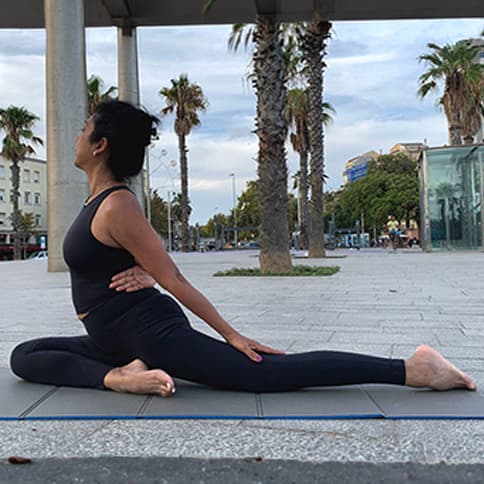
Every June, the wellness world fills up with articles about what yoga can do for you. Better sleep, less stress, a stronger core, a calmer mind. And honestly, none of that is wrong. Yoga has given me all of those things at different points in my life. But as I sat down to write something for this year’s International Yoga Day, I kept circling back to a question that felt a little uncomfortable to ask out loud: what if the most important thing yoga ever taught me had nothing to do with any of that? What if the thing that actually changed my life was not what yoga fixed, but what it helped me stop trying to fix altogether?
I want to be honest with you, because I think this Yoga Month deserves a different kind of conversation than the one we usually have.
For a long time, I came to yoga the same way I came to most things in my life: with a list. A list of things I wanted to improve, a list of things I hoped would change, a list of ways I wanted to feel different from how I currently felt. My back hurt, so I wanted yoga to fix that. I was stressed, so I wanted yoga to calm me down. I was not sleeping well, so I wanted yoga to sort that out too. I was, in many ways, using yoga the same way I used everything else: as a tool to make myself more manageable, more optimised, more okay.
And here is what I noticed over many years of practicing: yoga kept refusing to play that game with me.
The Moment I Realised I Had Been Missing the Point
There was a particular moment on the mat, years into my practice, when something shifted in a way I was not expecting. I was not doing anything complicated. I was just sitting still, paying attention to my breath, when I suddenly became aware of how much tension I had been carrying in my shoulders for what felt like months. Not because anything had happened that day. Just because I had finally slowed down enough to notice it was there.
And then I started noticing other things. How shallow my breathing had been all week. How long it had been since I had checked in with myself rather than just pushing through. How much I had been running from one responsibility to the next without ever pausing to ask how I was actually doing.
Yoga had not fixed any of that. But it had done something more valuable: it had shown it to me. And that awareness, that simple act of seeing clearly what was already there, turned out to be the thing that changed everything more than any posture ever had.
Why We Turned Yoga Into Something It Was Never Meant to Be
We live in a world that is very good at turning everything into a project. We track our steps, monitor our sleep, measure our output, and set goals for every corner of our lives. Even rest has become something we optimise. Even wellbeing has become something we achieve. And without most of us really noticing when it happened, we brought that same mindset into the yoga studio with us.
We started worrying about whether we were flexible enough. We started comparing ourselves to the person on the mat next to us. We started wondering if we were progressing at the right speed, doing the poses correctly, getting enough out of the class to justify the hour we had given it. We turned a practice that was designed to help us come home to ourselves into another arena where we could feel like we were not quite doing enough.
And I understand why, because I did exactly the same thing for years. The wellness industry is very good at selling us the idea that we are a problem to be solved, and yoga is not immune to being packaged and marketed in the same way. But the more time I have spent with this practice, the more certain I have become that yoga was never asking me to become someone else. It was asking me to pay attention to who I already am. That is a very different invitation, and it took me a long time to hear it properly.
Yoga has not helped me become a better version of myself. It has helped me come back to myself. Again and again, in ways I did not always expect or plan for.
The Part of Yoga That Nobody Really Talks About during this International Yoga celebration month
Here is the thing about yoga that does not make it into most of the Yoga Month content you will read this month. Yoga cannot remove the difficult things from your life. It cannot make grief disappear or eliminate the sources of your stress or prevent loss or change or uncertainty. If that is what you have been hoping it would do, I understand the disappointment, and I also want to say gently that the disappointment might be pointing at something worth exploring.
What yoga can do, when you give it the chance to do what it was actually designed to do, is help you meet those difficult things differently. It can help you notice how you respond to stress before that response takes over completely. It can help you recognise what your body is trying to communicate before the signal gets so loud it becomes impossible to ignore. It can help you build a steadier, kinder relationship with yourself, the kind that does not collapse under pressure but also does not require you to pretend the pressure is not there.
That might sound less impressive than the promises you see in the wellness world. But in my experience, it is the thing that actually lasts. It is the thing that is still with me on the days when nothing is going the way it should, when I am tired and overwhelmed and not at all the version of myself I would like to be. Yoga did not make those days disappear. But it taught me how to be with myself through them without making everything worse by fighting it.
Why Yoga and Ayurveda Have Always Belonged Together
This is something that feels personally very true to me, and it is also why the work we do at ASHAexperience feels so coherent to me from the inside. Yoga and Ayurveda share the same starting point: they both begin with listening. Ayurveda asks us to pay attention to what the body is communicating, to the signals that often go unnoticed in the busyness of daily life. Yoga creates the stillness that makes it possible to hear those signals at all. Neither of them begins by asking how to fix something as quickly as possible. They both ask something much gentler, and much harder to sit with: what is your body actually telling you right now, and have you given yourself enough quiet to hear it?
The answers do not always come quickly. They rarely arrive in a neat and convenient way. But both practices have taught me that real healing tends to begin with awareness before it begins with action, and in a world that is constantly pushing us to react and solve and optimise and move faster, that feels like something genuinely worth protecting.
What I Would Tell Someone Coming to Yoga for the First Time being motivated to celebrate International Yoga Day
If you are coming to yoga this month because it is International Yoga Day and you are curious, or because you are hoping it will help with something specific, or because you have tried it before and walked away a little disappointed and are wondering whether to give it another chance, I would say this: bring whatever you are carrying. Bring the list of things you want to fix. Bring the expectations. Bring the skepticism too, if you have it. All of that is welcome on the mat.
But also give yourself permission to be surprised by what yoga ends up offering you. Because in my experience, the gift it gives is rarely the one you came looking for. It tends to be something quieter, something you did not even know you needed until you were suddenly in the middle of it. And that something, in ways that are genuinely hard to explain to someone who has not felt it yet, has a way of staying with you much longer than any pose ever will.
Yoga did not fix me. And I am so grateful for that. Because what it did instead was far more interesting.
It helped me stop needing to be fixed in the first place.
A Note from ASHAexperience
At ASHAexperience, we see yoga as Bijoya describes it here: not a performance or a project, but a practice of coming back to yourself with honesty and care. Alongside Ayurveda, it is one of the most grounded and genuinely human approaches to wellbeing that we know. Not because it promises to solve everything, but because it teaches you how to listen before you reach for a solution.
If you are curious about exploring what yoga and Ayurveda might offer you together, whether you are navigating a health challenge or simply feeling that your body deserves more than what your daily routine is currently giving it, you can speak with Bijoya personally here.